<div className="border border-blue-100 bg-blue-50/40 rounded-2xl p-6 my-8">
<div className="flex items-center gap-2.5 mb-3 text-blue-800">
<svg className="w-5 h-5 text-blue-600 inline-block align-middle mr-2" fill="none" stroke="currentColor" strokeWidth="2.5" viewBox="0 0 24 24" xmlns="http://www.w3.org/2000/svg"><circle cx="12" cy="12" r="10"/><circle cx="12" cy="12" r="6"/><circle cx="12" cy="12" r="2"/></svg>
<h3 className="font-bold text-base m-0">頁首情境定位與分流</h3>
</div>
<div className="text-slate-600 text-sm leading-relaxed mb-4">
房地產交易與契約細節深度解析,助您掌握交易關鍵,規避潛在法律與財務風險。
</div>
<div className="grid grid-cols-1 sm:grid-cols-2 gap-4 pt-4 border-t border-slate-100 text-xs">
<div>
<span className="font-semibold text-slate-700"><svg className="w-4 h-4 text-rose-500 inline-block align-middle mr-1.5" fill="none" stroke="currentColor" strokeWidth="2.5" viewBox="0 0 24 24" xmlns="http://www.w3.org/2000/svg"><circle cx="12" cy="12" r="10" /><circle cx="12" cy="12" r="6" /><circle cx="12" cy="12" r="2" /></svg>適合讀者:</span>
<ul className="list-disc pl-4 mt-1 text-slate-500 space-y-1">
<li>進行購屋流程評估與契約簽署的置產人及首購族</li>
<li>研究交易與持有實務與交易防線的法務人員</li>
<li>欲防範購屋流程爭議與合約陷阱之房屋所有權人</li>
</ul>
</div>
<div>
<span className="font-semibold text-slate-700"><svg className="w-4 h-4 text-blue-500 inline-block align-middle mr-1.5" fill="none" stroke="currentColor" strokeWidth="2" viewBox="0 0 24 24" xmlns="http://www.w3.org/2000/svg"><path d="M10 13a5 5 0 0 0 7.54.54l3-3a5 5 0 0 0-7.07-7.07l-1.72 1.71" /><path d="M14 11a5 5 0 0 0-7.54-.54l-3 3a5 5 0 0 0 7.07 7.07l1.71-1.71" /></svg>姊妹篇引導:</span>
<ul className="list-disc pl-4 mt-1 text-slate-500 space-y-1">
<li>關於本專題的延伸實務防線?請讀 <a href="/blog/taiwan-home-buying-guide" className="text-blue-600 hover:underline">首購族自保特約SOP</a></li>
<li>關於本專題的進階契約對照?請讀 <a href="/blog/new-house-buying-guide" className="text-blue-600 hover:underline">新屋合約四大防禦線</a></li>
</ul>
</div>
</div>
</div>
<div className="not-prose my-8 grid grid-cols-1 md:grid-cols-3 gap-5">
<div className="p-5 bg-white border border-slate-100 rounded-2xl shadow-sm flex flex-col justify-between hover:border-blue-100 transition-all duration-300">
<div>
<span className="text-[10px] font-bold text-blue-600 tracking-wider uppercase">核心情境</span>
<div className="text-xs text-slate-600 mt-2 leading-relaxed font-medium">預售屋格局圖審查、中古屋現場看屋通風檢測,以及室內發霉壁癌、空氣品質惡劣的改善規劃。</div>
</div>
</div>
<div className="p-5 bg-white border border-slate-100 rounded-2xl shadow-sm flex flex-col justify-between hover:border-blue-100 transition-all duration-300">
<div>
<span className="text-[10px] font-bold text-blue-600 tracking-wider uppercase">適合讀者</span>
<div className="text-xs text-slate-600 mt-2 leading-relaxed font-medium">擔心室內甲醛、二氧化碳與潮濕壁癌,或考慮在客變與裝潢時期規劃安裝全熱交換器的屋主。</div>
</div>
</div>
<div className="p-5 bg-white border border-slate-100 rounded-2xl shadow-sm flex flex-col justify-between hover:border-blue-100 transition-all duration-300">
<div>
<span className="text-[10px] font-bold text-blue-600 tracking-wider uppercase">姊妹篇導航</span>
<div className="text-xs text-slate-600 mt-2 leading-relaxed font-medium">若您需要了解隔音設計,請參考 <a href="/blog/floor-soundproofing-58db-regulations" className="text-blue-600 hover:underline">樓板隔音設計指南</a>;若您想查看完整驗屋檢測,請參考 <a href="/blog/2026-home-inspection-checklist-sop-guide" className="text-blue-600 hover:underline">科學驗屋SOP全攻略</a>。</div>
</div>
</div>
</div>
<div className="not-prose my-8 p-6 bg-slate-50 border border-slate-200 rounded-3xl shadow-sm">
<div className="flex items-center gap-3 mb-6">
<div className="w-10 h-10 rounded-xl bg-blue-50 border border-blue-100/80 flex items-center justify-center shrink-0">
<svg xmlns="http://www.w3.org/2000/svg" viewBox="0 0 24 24" fill="none" stroke="currentColor" strokeWidth="2.5" strokeLinecap="round" strokeLinejoin="round" className="w-5 h-5 text-blue-600 block" style={{ display: 'block', margin: 'auto' }}><path d="M2 3h6a4 4 0 0 1 4 4v14a3 3 0 0 0-3-3H2z"></path><path d="M22 3h-6a4 4 0 0 0-4 4v14a3 3 0 0 1 3-3h7z"></path></svg>
</div>
<div>
<h3 className="font-bold text-slate-800 text-base m-0 leading-tight">30 秒精華速讀 (TL;DR)</h3>
<p className="text-[11px] text-slate-400 m-0 mt-0.5">房屋通風與全熱交換改善核心決策</p>
</div>
</div>
<div className="grid grid-cols-1 md:grid-cols-3 gap-5">
<div className="pl-4 border-l-4 border-blue-500 py-1 hover:bg-slate-100/50 rounded-r-xl transition-colors duration-200">
<span className="text-[10px] font-bold text-blue-600 tracking-wider uppercase">01 / 穿堂對流</span>
<h4 className="font-bold text-slate-800 text-sm mt-1 mb-1.5">格局開窗決定氣流上限</h4>
<div className="text-xs text-slate-600 leading-relaxed">
自然通風以<strong>南北座向最優</strong>,需至少在兩個不同座向的牆面上配置開窗(對流窗),僅單面開窗的房型氣流流通度會受限。
</div>
</div>
<div className="pl-4 border-l-4 border-amber-500 py-1 hover:bg-slate-100/50 rounded-r-xl transition-colors duration-200">
<span className="text-[10px] font-bold text-amber-600 tracking-wider uppercase">02 / 換氣指標</span>
<h4 className="font-bold text-slate-800 text-sm mt-1 mb-1.5">防禦二氧化碳與甲醛危害</h4>
<div className="text-xs text-slate-600 leading-relaxed">
人體舒適與健康的換氣基準為<strong>每小時換氣 0.5 次 (0.5 ACH)</strong>,室內 CO₂ 濃度應長期控制在 <strong>1000 ppm 以下</strong>。
</div>
</div>
<div className="pl-4 border-l-4 border-emerald-500 py-1 hover:bg-slate-100/50 rounded-r-xl transition-colors duration-200">
<span className="text-[10px] font-bold text-emerald-600 tracking-wider uppercase">03 / 機械換氣</span>
<h4 className="font-bold text-slate-800 text-sm mt-1 mb-1.5">密閉噪音與 PM2.5 解方</h4>
<div className="text-xs text-slate-600 leading-relaxed">
若面臨臨路噪音與空汙,應規劃<strong>全熱交換器 (ERV)</strong>,可在緊閉窗戶的狀態下排除甲醛,並阻絕 PM2.5,冷房損耗極低。
</div>
</div>
</div>
</div>
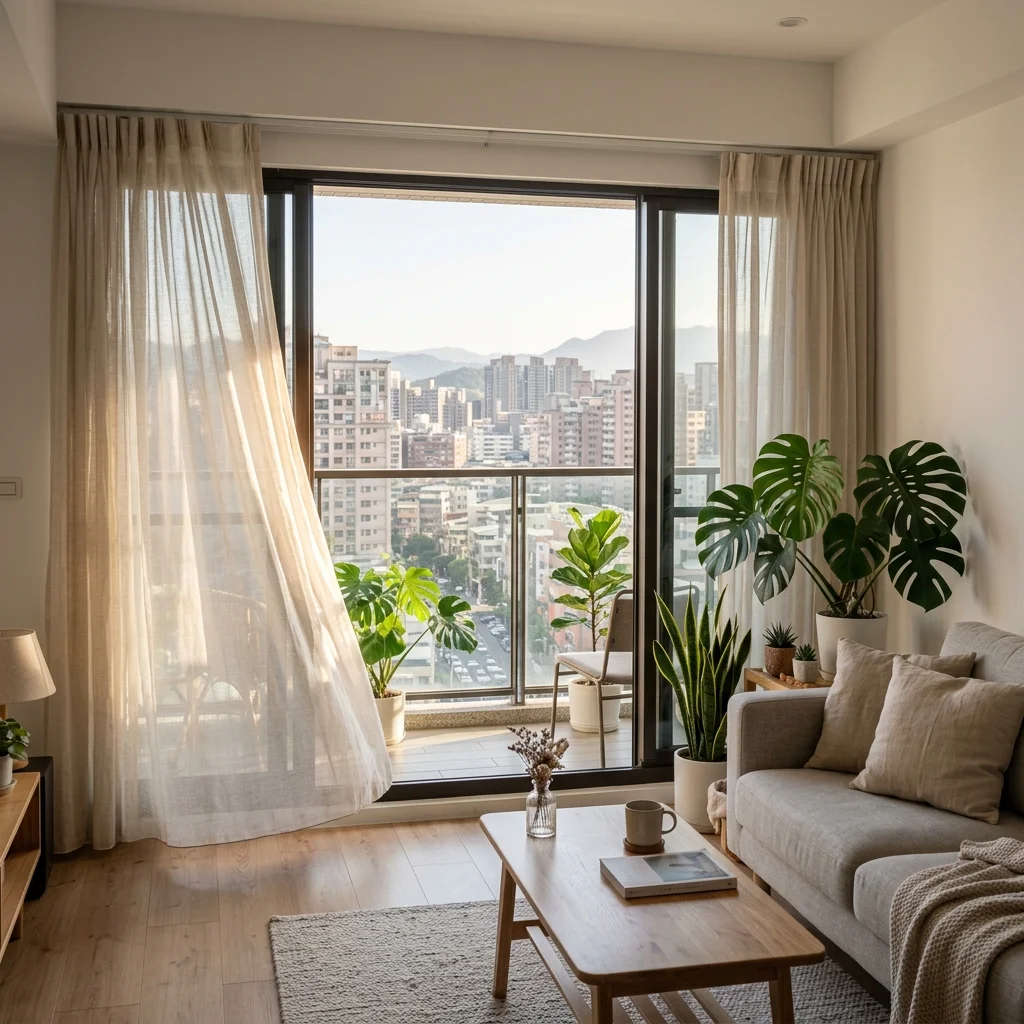
房屋通風是購置不動產時不可忽視的物理與健康指標。許多人僅聚焦於地段、採光與坪效等顯性條件,卻常忽略空氣流通對於居住品質的深遠影響。良好的通風不僅能顯著提升居住舒適度,排除廚房油煙與衛浴濕氣,更直接關係到居住者健康的維護,有助於預防過敏與呼吸道問題。同時,它也是維護房屋長期價值的關鍵要素,能有效避免壁癌、木作天花板及家具因濕氣潮濕而產生發霉與物理性損害。
---
## 一、為什麼房屋通風如此重要?
通風的物理本質是室內外空氣的流動與交換。它對居住環境與財產維護有著多維度的關鍵影響:
* <strong>健康與防禦有害氣體 (Health & EEAT)</strong>:充足的通溫能有效稀釋室內累積的二氧化碳 (CO₂),木作家具釋出的甲醛 (HCHO),以及揮發性有機物 (VOCs)。高濃度 CO₂(大於 1000 ppm)會導致人體昏沉、注意力不集中,而甲醛更是世界衛生組織 (WHO) 認定的一級致癌物。
* <strong>舒適度與空調省電 (Comfort & Energy Saving)</strong>:透過引入自然對流,可顯著改善室內悶熱感,減少冷氣的使用頻率,進而降低每月的電費開銷。
* <strong>預防受潮與壁癌 (Maintenance & Value)</strong>:台灣氣候高溫潮濕,通風是控制室內相對濕度的第一道防線。良好的通風能防禦牆面與天花板受潮發霉,避免壁癌的形成,保障裝潢的折舊壽命並維持房屋資產的市場價值。
---
## 二、通風設計的物理算式 ( KaTeX Formulas )
在建築物理學與空氣品質管理中,通風效能是由兩個核心算式決定的:
### 1. 換氣率公式 (Air Change Rate)
換氣率(每小時換氣次數,ACH)是評估室內空氣品質的核心指標。一般住宅的標準應維持在 <strong>0.5 ACH 以上</strong>(即每 2 小時將室內空氣完整置換一次):
$$ACH = \frac{Q}{V}$$
* <strong>ACH</strong>:每小時換氣次數 ($h^{-1}$)
* <strong>Q</strong>:每小時新鮮空氣引入量 ($m^3/h$)
* <strong>V</strong>:室內的物理淨空間體積 ($m^3$)
### 2. 二氧化碳濃度衰減與累積公式
若室內無機械換氣,在通風不良(新鮮空氣通風量 <strong>Q</strong> 趨近於 0)且有人活動的情況下,二氧化碳會迅速累積。其隨時間變化的濃度公式如下:
$$C_t = C_0 + \frac{G}{Q} \left(1 - e^{-\frac{Q}{V} t}\right)$$
* <strong>C_t</strong>:*t* 小時後的室內二氧化碳濃度 (ppm)
* <strong>C_0</strong>:室外新鮮空氣的二氧化碳濃度(通常為常數 400 ppm)
* <strong>G</strong>:室內人體呼出的二氧化碳生成速率 (L/h)
* <strong>Q</strong>:新鮮空氣通風量 (L/h)
* <strong>V</strong>:室內體積 ($m^3$)
<RechartsChart
type="line"
title="密閉臥室睡眠二氧化碳 (CO₂) 濃度隨時間變化趨勢"
note="數據設定:兩位成人睡眠、10 坪空間、換氣量為 0(完全密閉)"
unit="ppm"
data='[{"label":"0小時(睡前)","value":400},{"label":"1小時","value":700},{"label":"2小時(輕微昏沉)","value":1000},{"label":"4小時(明顯悶熱)","value":1600},{"label":"6小時(深眠缺氧)","value":2200},{"label":"8小時(起床頭痛)","value":2800}]'
/>
<strong>費曼轉譯</strong>:假設一個約 10 坪(高度 3 米,體積 <strong>V</strong> = $100 m^3$) of 密閉臥室,在沒有開窗且無引進新鮮空氣的狀態下,兩位成人睡眠 8 小時(呼出 <strong>G</strong> = 30 L/h),室內 CO₂ 濃度將從 400 ppm 飆升至 <strong>2800 ppm 以上</strong>,這正是隔天起床頭痛、昏沉的根本原因。
---
## 三、如何判斷房屋通風狀況?(看屋實戰技巧)
在看屋時,您可以透過以下系統化的步驟,快速評估目標房屋的先天通風品質,降低潛在的產權與屋況不對稱風險:
### 1. 格局與自然對流 (Natural Cross Ventilation) 評估
* <strong>檢查對流窗配置</strong>:確認房屋是否至少在兩個不同座向的牆面上設有開窗。氣流需要有「進口」與「出口」才能形成風路(如穿堂風)。僅單面開窗的格局(常見於單面採光套房),氣流易在屋深處停滯形成「風死角」。
* <strong>座向與風阻</strong>:在台灣地區,南北座向的建築物能最有效攔截夏季西南風與冬季東北季風。東西向房屋則因西曬熱輻射效應,容易導致室內蓄熱,若對流不順暢會極度悶熱。
* <strong>通風開窗比</strong>:依據《建築技術規則》設計規範,住宅有效通風開窗面積應達該居室樓地板面積的 <strong>1/20 (5%)</strong> 以上,這是自然通風的法規物理底線。
### 2. 現場簡易五感測試
* <strong>窗邊氣流測試</strong>:將所有對外窗與房門開啟,手持輕薄面紙或觀察髮絲在窗邊、走道上的飄動方向。若氣流平穩且流速一致,代表室內風路暢通。
* <strong>關窗悶熱測試</strong>:進入房屋後,先將所有門窗緊閉 10 分鐘,靜待室內熱量蓄積。隨後仔細感受是否悶熱異常,並以嗅覺評估是否有牆角霉味、排水孔回滲異味、或鄰居管道間傳來的油煙味。若有,代表大樓管道間逆止閥失效且室內自然換氣率極低。
<MdxMermaidFlowchartIndex289Block0 />
---
## 四、影響房屋通風的關鍵環境因子
* <strong>樓層高度與風速關係</strong>:一般而言,中高樓層(約 7-15 樓)避開了地面的濕氣與街道噪音,且不易受到鄰近矮房的阻擋,通風效果最為理想。低樓層易因棟距太近被鄰樓遮擋氣流;而超高樓層(15 樓以上)雖然風速強,但常伴隨巨大的風切噪音,且氣密窗往往因安全規範限制而無法完全開啟。
* <strong>棟距與峽谷效應</strong>:大樓間的棟距是自然風流動的生命線。如果棟距過近或四周被高樓包圍,風流會被直接阻斷。當風行經狹窄的樓縫時,會產生「文丘里效應」(狹管效應),局部風速會暴增,造成窗戶震動與風切聲,這在看屋時需特別注意。
---
## 五、通風改善方案 Bento 網格比較
當房屋存在先天通風不良的缺點時,必須透過後天的裝修工程或設備進行改善。以下是三種主流改善方案的深度對比:
<div className="not-prose my-8 grid grid-cols-1 md:grid-cols-3 gap-5">
{/* Option 1 */}
<div className="p-6 bg-white border border-slate-200 rounded-2xl shadow-sm flex flex-col justify-between hover:border-blue-100 transition-all duration-300">
<div>
<span className="text-[10px] font-bold text-slate-500 tracking-wider uppercase">方案一</span>
<h4 className="font-bold text-slate-800 text-base mt-1 mb-3">自然通風 + 循環扇</h4>
<ul className="list-disc pl-5 space-y-1.5 text-xs text-slate-600">
<li><strong>設備成本</strong>:極低(約新台幣 1,500 元至 5,000 元)</li>
<li><strong>PM2.5 過濾</strong>:無(需依賴防霾紗窗,效果有限)</li>
<li><strong>隔音效果</strong>:無(開窗會直接傳入戶外噪音)</li>
<li><strong>冷能損耗</strong>:高(開窗會導致冷氣流失,增加電費)</li>
</ul>
</div>
<div className="mt-4 pt-4 border-t border-slate-100 text-xs text-slate-500 font-medium">適用於:預算有限、無嚴重空汙與噪音影響之通風良好住宅。</div>
</div>
{/* Option 2 */}
<div className="p-6 bg-white border border-slate-200 rounded-2xl shadow-sm flex flex-col justify-between hover:border-blue-100 transition-all duration-300">
<div>
<span className="text-[10px] font-bold text-slate-500 tracking-wider uppercase">方案二</span>
<h4 className="font-bold text-slate-800 text-base mt-1 mb-3">無管道新風機</h4>
<ul className="list-disc pl-5 space-y-1.5 text-xs text-slate-600">
<li><strong>設備成本</strong>:中等(約新台幣 1.5 萬至 3 萬元)</li>
<li><strong>PM2.5 過濾</strong>:佳(配備 HEPA 濾網,過濾率大於 99%)</li>
<li><strong>隔音效果</strong>:佳(無需開窗,機器運轉音約 25-35 dB)</li>
<li><strong>冷能損耗</strong>:中等(單向引入外氣,會稍微加重空調負擔)</li>
</ul>
</div>
<div className="mt-4 pt-4 border-t border-slate-100 text-xs text-slate-500 font-medium">適用於:已裝潢成屋、面臨空汙與臨路噪音,無法進行大面積管線施工者。</div>
</div>
{/* Option 3 */}
<div className="p-6 bg-white border border-slate-200 rounded-2xl shadow-sm flex flex-col justify-between hover:border-blue-100 transition-all duration-300">
<div>
<span className="text-[10px] font-bold text-slate-500 tracking-wider uppercase">方案三</span>
<h4 className="font-bold text-slate-800 text-base mt-1 mb-3">吊頂式全熱交換器 (ERV)</h4>
<ul className="list-disc pl-5 space-y-1.5 text-xs text-slate-600">
<li><strong>設備成本</strong>:高(約新台幣 6 萬至 12 萬元,含施工)</li>
<li><strong>PM2.5 過濾</strong>:極佳(雙向強制換氣,高規過濾網阻絕汙染)</li>
<li><strong>隔音效果</strong>:極佳(完全閉窗運作,有效阻斷戶外喧囂)</li>
<li><strong>冷能損耗</strong>:極低(具備顯熱/全熱回收效率高達 70%-80%)</li>
</ul>
</div>
<div className="mt-4 pt-4 border-t border-slate-100 text-xs text-slate-500 font-medium">適用於:毛胚客變期、即將進行全面裝潢的中古屋與新成屋主,追求極致空氣品質者.</div>
</div>
</div>
---
## 六、全熱交換器 (ERV) 裝修施工防禦檢核卡
若您決定規劃最高規格的「吊頂式全熱交換器」,在裝潢施工過程中,務必親自與室內設計師或設備工程師確認以下四大核心物理條件,以防止破壞結構與運轉不良:
<div className="not-prose my-8 p-6 bg-white border border-slate-200 rounded-3xl shadow-sm">
<h4 className="font-bold text-slate-800 text-base m-0 mb-4 flex items-center gap-2">
<svg className="w-5 h-5 text-blue-600" fill="none" stroke="currentColor" strokeWidth="2.5" viewBox="0 0 24 24"><path strokeLinecap="round" strokeLinejoin="round" d="M9 12l2 2 4-4m6 2a9 9 0 11-18 0 9 9 0 0118 0z" /></svg>
ERV 全熱交換器裝修施工四大檢查要點
</h4>
<div className="space-y-4 text-xs text-slate-600">
<div className="flex items-start gap-3">
<div className="w-5 h-5 rounded-full bg-blue-50 text-blue-600 flex items-center justify-center font-bold shrink-0">1</div>
<div>
<strong>樑柱穿孔安全(最重要!)</strong>:風管出入室內外需要穿牆或穿樑。大樑<strong>絕對禁止任意鑽孔</strong>(特別是受剪力區與拉力區)。若必須鑽孔,需委託結構技師或地政士確認,或採用「過樑器」繞道,或從消防灑水管線預留孔穿過,嚴禁破壞結構安全。
</div>
</div>
<div className="flex items-start gap-3">
<div className="w-5 h-5 rounded-full bg-blue-50 text-blue-600 flex items-center justify-center font-bold shrink-0">2</div>
<div>
<strong>天花板淨高留置</strong>:吊頂式主機厚度通常在 21-25 公分之間,加上風管配置與坡度,天花板會被壓低約 30-35 公分。若室內淨高不足(低於 2.8 米),應將主機策略性安置於玄關、廚房或走道,避免壓低客廳與臥室的主視覺空間,防止產生壓迫感。
</div>
</div>
<div className="flex items-start gap-3">
<div className="w-5 h-5 rounded-full bg-blue-50 text-blue-600 flex items-center justify-center font-bold shrink-0">3</div>
<div>
<strong>保養檢修口預留</strong>:全熱交換器的濾網與熱交換核心每 3-6 個月需要取出清洗或更換。裝潢木作天花板時,<strong>主機正下方必須留設足夠尺寸的檢修口(一般為 45cm x 45cm 以上)</strong>,且檢修口位置不能被大衣櫃 or 高櫃阻擋。
</div>
</div>
<div className="flex items-start gap-3">
<div className="w-5 h-5 rounded-full bg-blue-50 text-blue-600 flex items-center justify-center font-bold shrink-0">4</div>
<div>
<strong>進排風口間距防禦</strong>:安裝於室外外牆的「引入新風口」與「排出髒風口」<strong>間距必須保持 1.5 米以上</strong>(或採用專用防雨短管分離方向),否則會發生「短路效應」,剛排出的室內髒空氣與甲醛又立刻被吸回室內,導致機器換氣效率歸零。
</div>
</div>
</div>
</div>
---
## 七、實用問答 (Q&A):釐清通風迷思
#### Q: :看房時最快、最直覺的通風檢測方式是什麼?
<strong>A1:開啟最遠對角線窗戶,站在主要走道上以體感與面紙檢測是否有微風流動。</strong>
看屋時若要快速確認,請先關閉房內的大部分冷氣,要求仲介開啟大門以及距離大門最遠端的對角線窗戶。若能感受到微風徐徐且面紙穩定飄動,代表該格局具備優良的自然風道。
#### Q: :高樓層是否一定比低樓層通風?
<strong>A2:不盡然。雖然高樓層風速普遍較大,但若過高(如 15 樓以上)可能伴隨嚴重的風切噪音,且窗戶常有防墜鎖等開啟限制,導致實際進風量反而變小。</strong>
最佳的通風平衡點通常在中高樓層(約 7-12 樓),既能避開低樓層的街道噪音與高濕氣,又不會面臨超高樓層的強烈風切干擾。
#### Q: :為了通風而開窗,卻吸入一堆髒空氣與噪音,該如何拿捏?
<strong>A3:在空汙嚴重或臨路噪音區,開窗會產生反效果。此時應「完全閉窗」並依靠「全熱交換器」或「新風機」進行換氣。</strong>
這類機械換氣設備內部裝有 HEPA 濾網,能在緊閉隔音氣密窗的狀態下,源源不絕引入過濾後的乾淨空氣,阻絕噪音的同時排除室內 CO₂ 與甲醛,這也是現代智慧住宅的標準配置。
---
## 八、結論:讓通風成為購屋的首要考量
良好的通風空間不僅是居家舒適的基本條件,更是一項攸關家人長期健康的「防禦性投資」,能有效防禦室內甲醛致癌與發霉壁癌的屋況折舊損失。在評估格局圖與實地看屋時,請務必將格局座向與通風開窗比列為第一層篩選指標。
若先天條件不足,也應於裝修初期(如客變期)將無管道新風機或全熱交換器編列入工程預算中,以科學的物理配置打造會呼吸的健康好宅。
---
<WordPressToolEmbed type="valuation_gap" />
## 官方查證資源
<div className="not-prose mt-12 mb-8">
<div className="grid grid-cols-1 md:grid-cols-2 gap-4">
<a href="https://iaq.moenv.gov.tw/" target="_blank" rel="noopener noreferrer" className="group flex items-start gap-4 p-5 rounded-2xl border border-slate-200 bg-white hover:border-blue-300 hover:shadow-md hover:shadow-blue-900/5 transition-all duration-300">
<div className="flex-shrink-0 w-8 h-8 rounded-full bg-blue-50 flex items-center justify-center group-hover:bg-blue-100 transition-colors">
<svg className="w-4 h-4 text-blue-600" fill="none" viewBox="0 0 24 24" stroke="currentColor"><path strokeLinecap="round" strokeLinejoin="round" strokeWidth="2" d="M10 6H6a2 2 0 00-2 2v10a2 2 0 002 2h10a2 2 0 002-2v-4M14 4h6m0 0v6m0-6L10 14"/></svg>
</div>
<div>
<h4 className="font-bold text-slate-800 text-[15px] m-0 group-hover:text-blue-600 transition-colors">環境部室內空氣品質資訊網</h4>
<p className="text-slate-500 text-xs mt-1 m-0">提供中華民國《室內空氣品質管理法》法規說明、室內二氧化碳 (1000 ppm) 與甲醛 (0.08 ppm) 標準值標準,以及室內空氣汙染防禦改善建議。</p>
</div>
</a>
<a href="https://glrs.moi.gov.tw/LawContent.aspx?id=FL001882" target="_blank" rel="noopener noreferrer" className="group flex items-start gap-4 p-5 rounded-2xl border border-slate-200 bg-white hover:border-blue-300 hover:shadow-md hover:shadow-blue-900/5 transition-all duration-300">
<div className="flex-shrink-0 w-8 h-8 rounded-full bg-blue-50 flex items-center justify-center group-hover:bg-blue-100 transition-colors">
<svg className="w-4 h-4 text-blue-600" fill="none" viewBox="0 0 24 24" stroke="currentColor"><path strokeLinecap="round" strokeLinejoin="round" strokeWidth="2" d="M10 6H6a2 2 0 00-2 2v10a2 2 0 002 2h10a2 2 0 002-2v-4M14 4h6m0 0v6m0-6L10 14"/></svg>
</div>
<div>
<h4 className="font-bold text-slate-800 text-[15px] m-0 group-hover:text-blue-600 transition-colors">全國法規資料庫 - 建築技術規則</h4>
<p className="text-slate-500 text-xs mt-1 m-0">查閱《建築技術規則建築設計施工編》第 43 條規定:住宅居室有效通風開窗面積應達該居室樓地板面積 5% (1/20) 以上之法定底線標準。</p>
</div>
</a>
</div>
</div>
## 官方查證系統資源
- <strong>[內政部不動產資訊平台](https://pip.moi.gov.tw)</strong>
*用途:查詢各都會區住宅房價指數、空屋率及住宅存量統計,客觀評估房產保值性。*